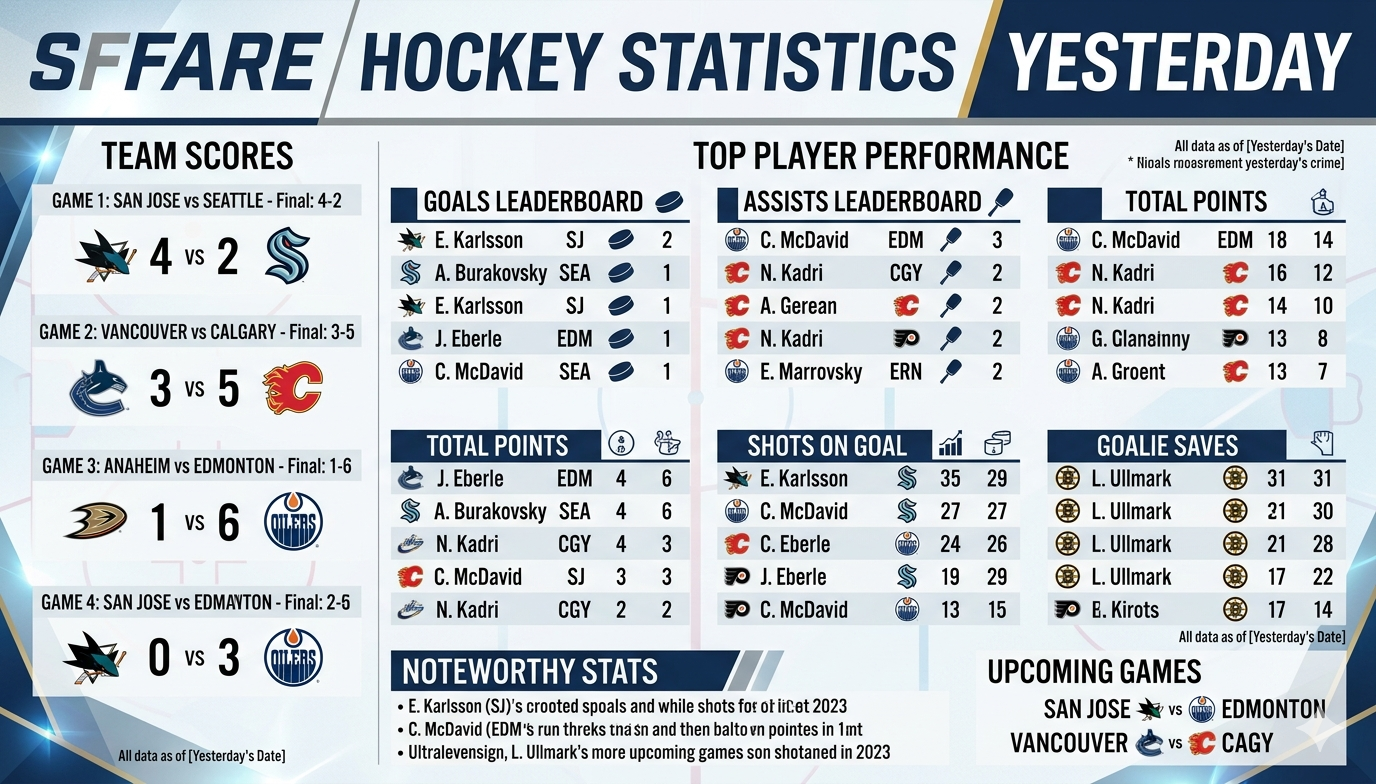
sffarehockey statistics yesterday – Complete Analysis of Hockey Performance and Trends
sffarehockey statistics yesterday provide a unique insight into the evolving dynamics of the sport and allow analysts, coaches, and fans to better understand the trends that are shaping modern hockey. In the United States, hockey continues to grow in popularity, with more teams, leagues, and youth programs contributing to a highly competitive environment. Tracking player performance and game outcomes is essential to maintaining competitive integrity and planning strategic improvements.
Evolution of Hockey Analytics
In recent years, hockey analytics have become increasingly sophisticated. What was once limited to goals and assists has now expanded into advanced metrics such as shot attempts, zone entries, and puck possession time. Analysts rely on sffarehockey statistics yesterday to determine not only the success of individual players but also the effectiveness of entire teams. This data-driven approach has revolutionized coaching decisions, drafting strategies, and in-game adjustments.
Historically, teams relied primarily on observational skills and traditional stats like wins, losses, and penalties. However, with the advent of modern tracking technologies, every shift, pass, and shot can now be quantified and analyzed. Advanced statistics allow for a more nuanced understanding of player contributions beyond simple goal-scoring.
Importance of Game-by-Game Analysis
Day-to-day statistics, such as those captured in sffarehockey statistics yesterday, are vital for assessing team momentum and identifying trends that may influence future matches. By analyzing performance at a granular level, coaches can adapt strategies to counter opposing teams’ strengths and weaknesses. Game-by-game analysis also provides valuable information for player development, helping individuals refine their skills in targeted areas.
For instance, a forward who consistently wins puck battles in the offensive zone but struggles with defensive positioning can be given specific training to improve balance in gameplay. Similarly, goaltenders benefit from analyzing shot locations and patterns from recent matches to anticipate and prepare for future opposition attacks.
Key Metrics That Shape Modern Hockey
Several metrics have become central to contemporary hockey analysis. These include expected goals (xG), Corsi and Fenwick ratings, plus-minus differentials, and zone time. Each of these metrics plays a unique role in evaluating player and team performance:
- Expected Goals (xG): Measures the probability of a shot resulting in a goal based on shot location, type, and game situation.
- Corsi and Fenwick Ratings: Track shot attempts and help evaluate puck possession and territorial dominance.
- Plus-Minus Differential: Indicates the goal differential when a player is on the ice.
- Zone Time: Assesses how long players control the puck in offensive and defensive zones.
Integrating these metrics with sffarehockey statistics yesterday allows teams to make informed tactical decisions while providing fans with richer insights into game dynamics.
Impact of Analytics on Coaching
Coaches increasingly rely on data to optimize line combinations, power-play setups, and penalty-kill formations. The analysis of sffarehockey statistics yesterday provides immediate feedback on which strategies are most effective under varying conditions. This allows coaches to adapt quickly rather than waiting for post-season evaluations.
Data-driven coaching has transformed how teams prepare for matches. Pre-game reports highlight tendencies in opposing players, enabling more precise defensive assignments. Similarly, in-game analytics provide real-time insights, allowing coaching staff to make adjustments that can swing the momentum of a game.
Player Performance and Development
Player performance tracking goes far beyond scoring. Metrics such as time on ice, shot accuracy, turnover rates, and faceoff wins are all vital indicators of a player’s impact. By studying sffarehockey statistics yesterday, teams can identify emerging talent and areas where players need additional coaching or conditioning.
Youth development programs now emphasize analytics as well. Young athletes are encouraged to understand their performance trends, fostering a culture of continuous improvement. Tracking statistics daily ensures that promising players receive the guidance necessary to progress through competitive levels efficiently.
Team Dynamics and Synergy
Hockey is inherently a team sport, and success depends heavily on the synergy between players. Metrics from sffarehockey statistics yesterday are essential in identifying which line combinations create the most effective play patterns. Analysts can determine whether certain players complement each other’s style or if adjustments are needed to optimize overall performance.
For example, a forward line may consistently generate scoring chances, but if defensive coverage is weak, the team may concede more goals than it scores. Using daily statistics, teams can realign player roles to achieve balanced and sustainable performance outcomes. a site luxuryinteriors.org blog
Fan Engagement Through Analytics
The rise of data analytics has also changed how fans engage with hockey. Fans can access sffarehockey statistics yesterday through websites, apps, and broadcasts, offering deeper insights into team strategies and player contributions. Fantasy hockey leagues and social media platforms have capitalized on these metrics, creating interactive experiences that enhance fan involvement.
Moreover, the use of statistics allows fans to have informed discussions about player performance and team strategies. Analytics have shifted conversations from subjective opinions to evidence-based debates, creating a more sophisticated and engaged fanbase.
Challenges in Interpreting Data
Despite the benefits, interpreting hockey data is not without challenges. Metrics like Corsi or expected goals provide valuable insights, but they must be contextualized. A high shot attempt count may indicate offensive pressure, but if it comes against weaker defensive teams, the data may be misleading. Analysts must consider the quality of opposition, game context, and sample size when evaluating sffarehockey statistics yesterday.
Additionally, human factors such as fatigue, injuries, and mental readiness can affect performance in ways that pure statistics cannot capture. Integrating qualitative assessments with quantitative data ensures a more holistic understanding of player and team dynamics.
Innovations in Hockey Analytics
The future of hockey analytics promises even more sophisticated approaches. Artificial intelligence and machine learning algorithms are increasingly used to predict player performance, injury risks, and optimal line combinations. Wearable technology allows real-time tracking of players’ speed, heart rate, and stamina, providing insights previously unavailable.
By combining traditional metrics with these innovations, teams can gain unprecedented insight into their strengths and weaknesses. Analysis of sffarehockey statistics yesterday can be enriched with predictive models to forecast outcomes and optimize game strategies more effectively.
Case Studies from Recent Matches
Several recent matches illustrate the importance of daily hockey statistics. Teams that effectively utilized sffarehockey statistics yesterday were able to make crucial mid-game adjustments, outperforming opponents who relied solely on intuition or traditional scouting reports. For instance, defensive units that monitored opponent shot tendencies reduced scoring chances and controlled game tempo more effectively.
Similarly, forwards who analyzed their scoring zones and shot efficiency were able to position themselves better, improving overall offensive productivity. These examples highlight how data-driven insights can translate into tangible performance improvements on the ice.
The Role of Technology in Data Collection
Technological advances have made the collection of hockey statistics more accurate and efficient. High-speed cameras, tracking sensors, and specialized software capture every movement on the ice. This enables analysts to generate sffarehockey statistics yesterday with precision, covering aspects such as shot speed, puck movement, and player positioning.
The combination of hardware and software ensures that the data is both comprehensive and actionable. Teams now have access to detailed reports immediately after games, allowing for timely adjustments and post-game analyses.
Preparing for Future Seasons
Long-term planning in hockey relies heavily on consistent and accurate data collection. By reviewing trends in sffarehockey statistics yesterday, management teams can make informed decisions about player trades, draft selections, and training investments. This strategic approach helps ensure that teams remain competitive over multiple seasons.
Furthermore, longitudinal data allows coaches to track player development trajectories, identify potential breakout stars, and prevent declines in performance. This proactive approach to management is increasingly essential in professional hockey.
Conclusion
In summary, sffarehockey statistics yesterday are more than just numbers—they are a lens through which the intricacies of hockey can be understood. From player development to coaching strategies, team dynamics to fan engagement, these statistics inform nearly every aspect of the sport. As technology continues to evolve, the scope and accuracy of hockey analytics will only expand, offering deeper insights and more strategic advantages.
Whether in the United States or across international leagues, the use of daily performance metrics has transformed hockey into a sport where data and intuition coexist, providing fans and professionals alike with a richer, more informed experience. The integration of analytics ensures that the future of hockey remains competitive, exciting, and continuously evolving.